Mars and Large Stars in the Early Universe – 8.26pm Tuesday 9th September 2025
Mars and Large Stars in the Early Universe – 8.26pm Tuesday 9th September 2025
Firstly, there is a ‘new’ theory of very large stars in the Early universe creating black holes. There are persons in the astronomy field who know perfectly well that I theorized that back in 2014/15, so that aspect of the authors work isn’t new. Additionally, articles about Mars in recent years are almost a complete copy of my work from a decade ago. And there are many other examples I could mention. Naturally, it’s very distressing and every single time I have written to bring it to the specific authors’ attention, my communications are totally ignored. The various authors may say they had no idea, but many in the field would see these articles who absolutely ‘do’ know of my work, yet the practice continues and people in the astronomy field are aware of it but choose to be silent. Thus causing an additional distress for me, because it implies these people have the notion that they can behave this way, in the belief that they won’t be held accountable.
May I again remind people all my work is copyright and belongs to me. I am not your free resource! Academics behaving criminally is utterly abhorrent.
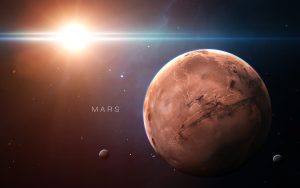
To Mars. We now know that there was a vast amount of water in Mars (which I did theorize more than a decade ago). The planet’s state indicated to me that the water had sat for a very long time, absent of tidal activity. Further, I believe that vast ocean turned the colour of rust and did sit for millions of years. I suspect it contributed to destroying what we would consider a life sustaining atmosphere. If life did commence in the ocean, it perished sadly and I am confident that Mars did once have a single moon much like Earth has. Looking at Mars hemispherically, it’s possible that one hemisphere held the vast body of ocean almost entirely. It leached and dissolved the area of land it occupied and once it finally disappeared, it left a land mass, extremely eroded, which we now see today. I expect there were rivers on the other, mountainous, hemisphere but it’s likely that weather was also negatively impacted globally, by the conditions. I have long suspected it was the loss of a single, functional moon that sadly caused Mars to be as we see it today. Did Mars take any steps, could it have altered its tilt perhaps? But there does seem, to me, to have been some internal activity on Mars, to salvage a hemisphere while having to write off the other, as a matter of necessity. Not to support life as we know it, as that was no longer possible, but for the planet itself to survive the disaster. And as I previously theorized, Olympus Mons had to be as tall as it was to get above the water level, because all planets like Earth, Mars, Venus etc., have to have volcanic activity and open vents above water level.
Fiona MacLeod (C)